
70 GSM vs 80 GSM Copy Paper: What Wholesale Buyers Should Order
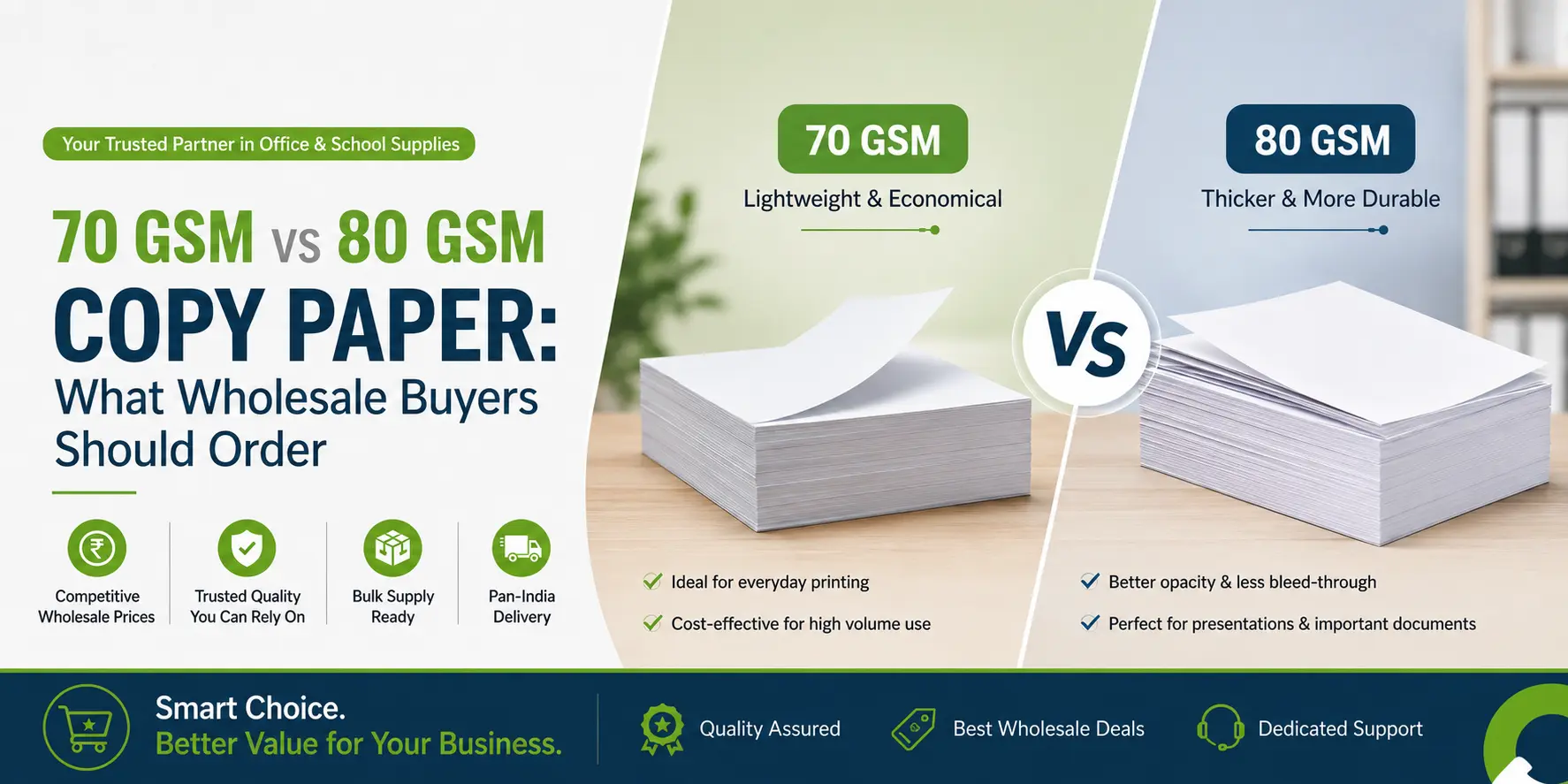
When you're buying a few reams for an office, the choice between 70 GSM and 80 GSM copy paper barely matters. When you're buying a full container, it decides your margin.
For wholesalers, distributors and procurement managers across Africa, the difference between these two paper weights ripples through everything that matters to a bulk order: the price you quote your customers, the number of reams you fit in a container, how your paper performs in the field, and how many complaints land back on your desk. Get it right and you win repeat tenders. Get it wrong and you're sitting on stock that jams printers or costs too much to move.
This guide breaks down the real, order-level differences — not just the textbook ones — and shows you how to decide which weight to order for your market.
What GSM actually means (and why it decides your landed cost)
GSM stands for grams per square metre — the weight of a single square metre of that paper. A 70 GSM sheet weighs 70 grams per square metre; an 80 GSM sheet weighs 80 grams. That 10-gram gap sounds trivial until you multiply it across half a million sheets in a shipment.
Here's what it looks like in real numbers for standard A4:
- A 70 GSM ream (500 sheets) weighs about 2.18 kg.
- An 80 GSM ream weighs about 2.49 kg.
- Across a standard 5-ream box, that's roughly 10.9 kg vs 12.5 kg — the 80 GSM box is about 14% heavier.
Because copy paper is dense and shipping containers usually hit their weight limit long before they run out of space, that 14% is not a rounding error. It's the difference between how many reams you can legally load — and therefore your freight cost per ream landed at Lagos, Mombasa, Tema or Durban. We'll come back to this, because it's the factor most first-time importers overlook.
GSM ≠ thickness — the quick clarification
A common mix-up: GSM measures weight, not thickness. Two papers of the same GSM can feel slightly different depending on the pulp and how it's calendered (pressed). That said, within the same product line, higher GSM does mean a thicker, stiffer, more opaque sheet. For practical buying, treat 80 GSM as the "premium everyday" weight and 70 GSM as the "efficient high-volume" weight.
70 GSM vs 80 GSM at a glance
| Factor | 70 GSM | 80 GSM |
|---|---|---|
| Weight per ream (A4) | ~2.18 kg | ~2.49 kg |
| Feel & stiffness | Lighter, more flexible | Firmer, more premium |
| Opacity / show-through | Good; slight ghosting on heavy double-sided or images | Higher opacity; cleaner double-sided printing |
| Best for | High-volume internal printing, notes, drafts, schools | Client-facing documents, reports, contracts, government & corporate use |
| Double-sided printing | Acceptable for text | Preferred |
| Printer jam risk | Slightly higher in older/heavy-duty machines | Lower; handles high-speed copiers well |
| Cost per ream | Lower | Higher |
| Reams per container | More (lighter) | Fewer (heavier) |
| Perceived quality | Economy / value | Standard / professional |
The five factors that should drive your order decision
1. Print quality and show-through
The most visible difference to your end customer is show-through — how much printed text or images bleed through to the other side of the page. 80 GSM is more opaque, so double-sided documents look crisp and professional. 70 GSM is perfectly readable for single-sided text and light double-sided work, but heavy ink coverage, charts or images can "ghost" through.
Rule of thumb: if your buyers print reports, contracts, presentations or anything a client will see, 80 GSM protects your reputation. If they print internal drafts, worksheets, receipts or high-volume classroom material, 70 GSM does the job at a lower price.
2. Printer and copier compatibility
Not every machine in the field is new. Across many African offices, schools and government departments, printers and copiers run for years under heavy load. Heavier, stiffer 80 GSM stock feeds more reliably through high-speed copiers and duplex units, with fewer jams and misfeeds. 70 GSM runs well in most modern printers but can be more sensitive in older, high-throughput machines.
If your customers are banks, ministries or large corporates running fleets of high-speed copiers, lean toward 80 GSM. If they're smaller offices, retailers and schools with standard desktop printers, 70 GSM is a strong value option.
3. Cost per ream vs cost per page
70 GSM is cheaper per ream — that's the obvious win, and it's why price-sensitive buyers and large-volume users gravitate to it. But smart buyers look at cost per usable page and cost per satisfied customer, not just the sticker price. A slightly cheaper ream that jams a copier or triggers "too thin" complaints can cost you more in returns and lost accounts than you saved.
The right move is to match the weight to the segment: order 70 GSM for your volume/economy customers and 80 GSM for your quality/corporate customers — often in the same shipment.
4. Freight, container loading and landed cost (the factor most buyers miss)
This is where wholesale buying differs completely from retail. Because 80 GSM boxes are about 14% heavier, a weight-limited container holds roughly 14% fewer reams of 80 GSM than 70 GSM. That directly raises your freight cost per ream on the heavier stock.
The true comparison isn't "70 GSM ream price vs 80 GSM ream price." It's: (Ream price + freight per ream + duties) landed at your port.
For long-haul ocean freight into African ports, that freight component is significant — which often makes 70 GSM even more attractive for high-volume, price-driven segments, and makes it essential to plan your container mix deliberately. A good sourcing partner will help you calculate this before you commit, not after.
5. Climate and storage in African markets
Paper is hygroscopic — it absorbs moisture from the air. In humid coastal and tropical regions, poorly stored paper curls, jams and loses its crispness. Heavier 80 GSM stock is a little more resilient to handling and humidity, but storage discipline matters more than GSM: keep reams sealed, off the floor, out of direct sun, and in a dry environment until sale.
When you're ordering in bulk, ask your supplier about moisture-resistant wrapping and export-grade packaging built for long transit and warehouse storage in warm, humid climates. This is a genuine quality differentiator that protects your stock all the way to the end user.
So which should you order? A quick decision guide by buyer type
- You supply schools, universities and high-volume print shops: Lead with 70 GSM. Volume and price sensitivity dominate; single-sided and text-heavy printing forgives the lighter weight.
- You supply banks, ministries, corporates and law firms: Lead with 80 GSM. Double-sided documents, professional presentation and heavy-duty copiers reward the heavier stock.
- You supply general retailers and mixed offices: Stock both — 70 GSM as the value line, 80 GSM as the standard line. It lets you serve every price point and win more tenders.
- You're bidding on a specific tender: Order exactly the GSM the tender specifies (often 70, 75 or 80 GSM). Confirm the spec in writing before you commit stock.
- You want a middle ground: Consider 75 GSM, a popular compromise in many African markets that balances economy and quality in a single SKU.
Common mistakes wholesale buyers make with GSM
- Judging only by ream price. The cheapest ream isn't the cheapest landed ream once freight is added.
- Assuming one GSM fits every customer. Different segments want different weights — a single-SKU strategy leaves money and tenders on the table.
- Ignoring brightness and opacity. Two "80 GSM" papers can look very different; always confirm brightness/whiteness and opacity, not just weight.
- Skipping a sample. Never commit a container to a new spec without approving a physical sample first.
- Underestimating packaging. Weak wrapping in humid transit ruins otherwise good paper before it reaches the shelf.
Why African importers source their copy paper through GoKart Enterprise
Choosing between 70 GSM and 80 GSM is only half the job. The other half is sourcing it from a partner who ships the right spec, at the right price, with paperwork that clears customs cleanly and packaging that survives the journey. That's where GoKart Enterprise comes in.
As India's trusted B2B export enterprise, GoKart already supplies stationery and office essentials to buyers across Nigeria, Ghana, Kenya, Tanzania, Ethiopia, South Africa and beyond — serving 27+ countries worldwide. For copy paper buyers, that translates into real advantages:
- Direct sourcing, no middlemen — you get manufacturer-level pricing on both 70 GSM and 80 GSM, so your margins stay healthy.
- Order the right mix for your market — GoKart helps you decide the ideal split of weights and brightness levels for your customer segments, instead of guessing.
- Flexible MOQs with volume discounts — start at a workable quantity and scale as your accounts grow.
- Export-ready documentation — clean, complete paperwork so your consignment moves through African ports without costly delays.
- Export-grade, moisture-aware packaging — built for long ocean transit and warehouse storage in warm, humid climates.
- A 24-hour quote response — tell GoKart your GSM, quantity and destination port, and get a landed-cost-friendly quote back fast.
In short: you decide the spec; GoKart makes sure it lands correctly, affordably and on time — so you can quote your own customers with confidence.
How to place a smart bulk order
- Define your segments. Decide which customers need 70 GSM (value/high-volume) and which need 80 GSM (corporate/client-facing).
- Confirm the spec. Lock in GSM, brightness/whiteness, sheet size (A4/A3/Legal) and reams per box.
- Request a sample. Approve a physical sample before committing a container.
- Get a landed-cost quote. Ask GoKart for a quote to your port, including packaging and documentation.
- Plan your container mix. Balance weight (freight) against your sales mix to maximise reams per container.
- Order and scale. Start within a comfortable MOQ, then increase as demand grows.
Frequently asked questions
Is 80 GSM always better than 70 GSM?
No. 80 GSM is higher quality and better for double-sided and client-facing printing, but 70 GSM is more economical and ideal for high-volume, single-sided use. The "better" choice depends on your customers and your margins.
Which GSM is most popular in African markets?
70, 75 and 80 GSM are all widely used. 70 GSM leads in price-sensitive, high-volume segments; 80 GSM is preferred by corporates and government; 75 GSM is a common middle ground.
How many sheets are in a ream, and how many reams in a box?
A standard ream holds 500 sheets, and copy paper is typically boxed in 5 reams (2,500 sheets), though this can vary by brand and order.
Does GSM affect shipping cost?
Yes. Heavier 80 GSM stock means fewer reams per weight-limited container, so freight cost per ream is higher. Always compare landed cost, not just ream price.
Can I order both 70 GSM and 80 GSM in one shipment?
Absolutely — and for many distributors that's the smartest strategy. GoKart Enterprise can supply a mixed consignment matched to your customer segments.
What's the minimum order quantity?
GoKart offers flexible MOQs with volume discounts. Share your destination and quantity for a tailored quote.
Order the right paper for your market — with a partner who gets it landed
Whether your customers need economical 70 GSM for high-volume printing or premium 80 GSM for professional documents, tell GoKart Enterprise your GSM, quantity and destination port — and get a quote back within 24 hours.
Request Your 24-Hour Quote📧 info@gokartenterprise.com | 📞 +91 95864 61515 | 🌐 gokartenterprise.com