
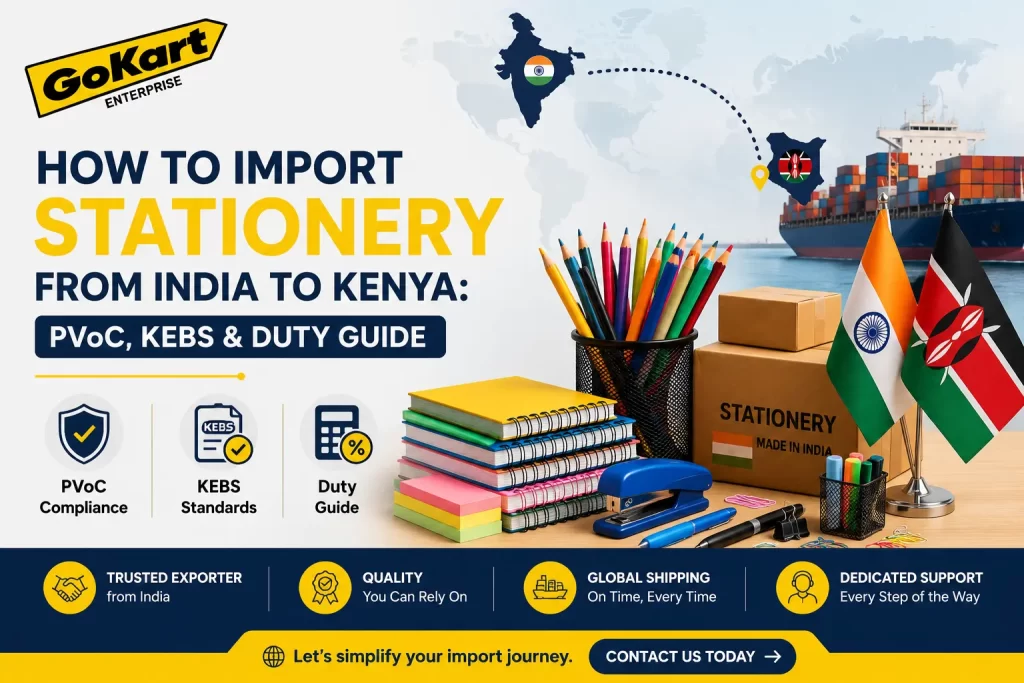
If you run a bookshop chain in Nairobi, supply schools in Mombasa, or win government tenders for office supplies, you have probably noticed the same thing: a large share of the pens, notebooks, and files on Kenyan shelves are made in India. That is no accident. Learning how to import stationery from India to Kenya the right way can lower your cost per unit, widen your product range, and give you a dependable supply line that holds up through peak school seasons.
This guide walks you through the whole journey — from picking an exporter and confirming quality, to satisfying the Kenya Bureau of Standards (KEBS), obtaining a PVoC Certificate of Conformity, estimating your duties, and getting your container safely to the Port of Mombasa. The aim is simple: help you import with fewer surprises and clearer paperwork.
A quick, honest note before we start. Regulations, levy rates, and approved-agency lists change from time to time. Treat everything here as a practical roadmap, not legal or tax advice — and always confirm the current requirements with KEBS, the Kenya Revenue Authority (KRA), or a licensed clearing agent before you ship.
Why Kenya Imports Stationery from India
India has grown into one of the world’s most active stationery manufacturing hubs, and Kenyan buyers benefit directly from that scale. Before you work out how to import stationery from India to Kenya in practical terms, it helps to understand why the trade lane works so well — because that context makes it easier to negotiate and plan.
Here are the main reasons Kenyan importers keep coming back to Indian suppliers:
- Affordable manufacturing. India’s large, competitive manufacturing base and lower production costs generally translate into keen factory prices — which matters when your margins live and die on cents per pen.
- Bulk supply capacity. Established Indian exporters are built for volume. Whether you need a few thousand notebooks or a full 40-foot container of mixed stationery, the ecosystem can usually absorb the order.
- OEM and private labeling. Many manufacturers offer OEM and private-label production, so you can sell pens, exercise books, and files under your own brand rather than someone else’s.
- Export-ready manufacturers. Suppliers who export regularly already understand documentation, packaging standards, and shipping timelines — which reduces friction for you.
- Consistent quality. Reputable factories run their own quality checks, giving you steadier product performance batch after batch.
- Faster sourcing. With so many product categories under one roof, you can often consolidate a full order from a single exporter instead of chasing ten different vendors.
Put together, these factors explain the appeal: competitive pricing, a mature manufacturing ecosystem, dependable quality, huge variety, and reliable export logistics. For most Kenyan wholesalers and distributors, that combination is hard to beat.
Popular Stationery Products Imported from India
Buyers rarely import just one item — they build a catalogue. India supplies practically every stationery category a Kenyan retailer, school, or office could need. The most commonly imported lines include:
Writing instruments
- Ball pens
- Gel pens
- Pencils (wooden and mechanical)
- Markers and permanent markers
- Highlighters
Correction and desk tools
- Erasers
- Sharpeners
- Rulers, geometry boxes, and math sets
Paper and books
- Notebooks and exercise books
- Diaries and register books
- Paper products and reams
Filing and office stationery
- Files, folders, and box files
- Staplers, punches, and clips
- General office stationery
Classroom and creative supplies
- Whiteboard accessories (markers, dusters, cleaning sprays)
- Art supplies such as crayons, colour pencils, and paints
- School stationery kits and combo packs
Whether your focus is school stationery for the January and May buying seasons, office stationery for corporate clients, or art supplies for retail, sourcing across these categories from one reliable exporter keeps your logistics simple and your pricing sharp.
Featured-snippet summary: The stationery most commonly imported from India to Kenya includes ball pens, gel pens, pencils, erasers, sharpeners, notebooks, files, markers, whiteboard accessories, geometry boxes, art supplies, and paper products — spanning both school and office ranges.
Step-by-Step: How to Import Stationery from India to Kenya
Once you know what you want, the how becomes a repeatable process. This is the practical heart of the whole exercise — the full path most importers follow, start to finish.
1. Find an exporter. Shortlist experienced Indian stationery exporters who serve African markets and can support your product mix. (We cover how to vet them further down.)
2. Select your products. Decide on categories, specifications, quantities, and whether you want generic or private-label branding.
3. Request a quotation. Ask for pricing on a clear basis — usually FOB (Free On Board) or CIF (Cost, Insurance, Freight to Mombasa). Confirm currency, MOQ, and lead times up front.
4. Order samples. Never skip this. Samples let you check ink flow, paper GSM, print quality, and packaging before you commit to a full order.
5. Confirm the Proforma Invoice. This document sets out products, quantities, prices, Incoterms, and payment terms. It is also the basis for your Import Declaration Form in Kenya.
6. Agree payment terms. Common structures include an advance deposit with balance before shipment, or a Letter of Credit for larger orders. Agree what protects both sides.
7. Production. The factory manufactures and packs your goods, ideally with your branding and export-grade cartons.
8. Documentation and compliance. Your exporter prepares shipping documents, and — crucially — arranges PVoC inspection so you receive a Certificate of Conformity (more on this below).
9. Shipping. Goods move by sea or air from an Indian port such as Nhava Sheva or Mundra to the Port of Mombasa.
10. Customs clearance. Your licensed clearing agent lodges the entry with KRA, presents your documents and Certificate of Conformity, and pays the assessed duties and taxes.
11. Delivery. After clearance, your container is released and transported to your warehouse or store.
Follow this sequence and the process becomes predictable. The two stages first-time importers underestimate most are compliance (step 8) and clearance (step 10) — so plan those early rather than at the last minute.
Required Import Documents
Customs clearance runs on paperwork. Missing or inconsistent documents are the number-one cause of delays and demurrage charges at Mombasa. Prepare these carefully:
| Document | What it does | Prepared by |
|---|---|---|
| Commercial Invoice | States the goods, quantities, and transaction value used to assess duty | Exporter |
| Packing List | Details cartons, weights, and dimensions for inspection and handling | Exporter |
| Bill of Lading (or Airway Bill) | The carrier’s contract and title document for your shipment | Shipping line / freight forwarder |
| Certificate of Origin | Confirms the goods were made in India | Exporter / chamber of commerce |
| Certificate of Conformity (CoC) | Proves PVoC compliance with Kenyan standards | KEBS-appointed inspection agency |
| Insurance Certificate | Evidence of cargo insurance (needed for CIF value) | Exporter or importer |
| Import Declaration Form (IDF) | Kenya’s customs declaration lodged with KRA | Importer / clearing agent |
| Import permits (if applicable) | Required only for specific regulated goods | Relevant Kenyan authority |
Most standard stationery does not require special import permits, but always confirm your specific products with your clearing agent — classification can hinge on the exact item and its HS code. Keep every figure consistent across all documents; even a small mismatch in quantity or value can trigger a query.
What is KEBS?
KEBS stands for the Kenya Bureau of Standards. It is the national body responsible for standardisation, quality assurance, and conformity assessment in Kenya. If you import into Kenya, KEBS is one of the two agencies (alongside KRA) you will deal with most.
Why does KEBS compliance matter to a stationery importer?
- Product quality and safety. KEBS sets and enforces standards so that goods entering the Kenyan market meet defined quality and safety benchmarks. For stationery, this can touch on materials, labelling, and — for items like markers or crayons — safety of contents.
- Import regulation. KEBS administers the framework that governs which imported products need conformity assessment before entry.
- Smoother customs clearance. Goods that arrive with the correct KEBS documentation (particularly a valid Certificate of Conformity) move through clearance far more easily than those without it.
- Market trust. Compliant products protect your reputation with schools, government buyers, and retail chains who expect standards to be met.
In short, treating KEBS compliance as part of your sourcing plan — not an afterthought — keeps your goods moving and your business credible. Always check the latest KEBS guidance for your product category before you order, as standards and requirements are updated periodically.
What is PVoC?
PVoC stands for Pre-Export Verification of Conformity. It is the KEBS programme that checks regulated goods in the country of export — in this case, India — before they are shipped to Kenya.
Why Kenya requires it. The idea is to catch non-compliant or substandard goods at the source rather than at Mombasa. That protects Kenyan consumers, supports fair competition, and reduces the risk of your cargo being detained or destroyed on arrival.
How the inspection process works. In practice, your exporter (or you) engages a KEBS-appointed inspection agency in India. Depending on how often you ship and your product type, verification may involve physical inspection, product testing against the applicable standard, and a review of documents. When the shipment passes, the agency issues a Certificate of Conformity (CoC) — the key document Kenyan customs looks for.
Approved inspection agencies. KEBS appoints specific conformity assessment bodies to run PVoC, and the panel is reviewed and renewed periodically. Agencies commonly appointed to this work have included firms such as SGS, Bureau Veritas, Intertek, and TÜV, among others. Because the approved list changes between contract cycles, always confirm the current KEBS-appointed agencies before booking an inspection.
The benefits.
- Faster, smoother customs clearance in Mombasa
- Lower risk of detention, penalties, or rejected cargo
- Assurance that what you ordered actually meets Kenyan standards
- A cleaner paper trail for your own buyers and auditors
One practical warning worth repeating: shipments that arrive without a valid Certificate of Conformity typically face extra inspection and additional charges, and can be significantly delayed. Arranging PVoC before shipment is almost always cheaper and faster than dealing with a destination-inspection route after the fact. Confirm the exact procedure and any exemptions with KEBS or your inspection agency for your specific goods.
Import Duty & Taxes on Stationery in Kenya
Every Kenyan importer needs a working estimate of landed cost — the all-in price after taxes and fees. On imported stationery, several charges can apply, and they are generally calculated on the customs value of your goods (typically the CIF value at Mombasa).
The charges you are most likely to encounter include:
- Import Duty — a customs duty applied according to the product’s tariff classification (HS code). Rates differ from one product category to another.
- Value Added Tax (VAT) — a consumption tax applied on eligible imports, generally calculated on the customs value plus duty and any other applicable charges.
- Import Declaration Fee (IDF) — a fee charged on imports to cover declaration and processing, calculated as a percentage of the customs value.
- Railway Development Levy (RDL) — a levy applied to imported goods to fund infrastructure, also calculated as a percentage of the customs value.
- Other charges — depending on your goods and shipment, you may also face port handling, storage, clearing-agent fees, and — if you skip PVoC — additional destination-inspection charges.
Here is the part every honest guide must be clear about: specific rates and percentages change with each Finance Act and vary by HS code. Recent Kenyan budget cycles have adjusted several of these figures, and they can move again. So rather than quote a number that may already be out of date, we strongly recommend you:
- Confirm the correct HS code for each stationery item with your clearing agent.
- Verify the current duty, VAT, IDF, and RDL rates directly with the Kenya Revenue Authority (KRA) or a licensed customs broker.
- Ask your agent for a full landed-cost estimate before you commit to an order.
Doing this small amount of homework up front turns “surprise” costs into planned costs — and protects your margins. If you would like help lining up the export-side documents that feed into this calculation, our team can assist.
Shipping Methods from India to Kenya
You have two realistic ways to move stationery from India to Kenya: sea freight and air freight. Most stationery importers use the sea, but both have their place.
| Factor | Sea Freight | Air Freight |
|---|---|---|
| Cost | Lower per unit — best for volume | Higher per kilogram |
| Transit time | Longer (typically a couple of weeks-plus for the ocean leg, before port and clearance) | Faster — days rather than weeks |
| Best for | Bulk orders, full or shared containers | Small, urgent, or high-value shipments |
| Typical use | Regular restocking, seasonal school orders | Samples, top-up orders, tight deadlines |
Sea freight is the workhorse of the stationery trade. You can ship a full container load (FCL) for larger orders or a shared container (LCL) for smaller ones. Goods usually depart from major Indian ports such as Nhava Sheva (Mumbai) or Mundra (Gujarat) and arrive at the Port of Mombasa, Kenya’s main gateway, from where cargo moves inland to Nairobi and beyond.
Air freight costs more but shines when speed matters — for example, rushing samples, replacing a shortfall, or hitting a tender deadline. For heavy, bulky, relatively low-value goods like notebooks and reams, though, air freight rarely makes economic sense at scale.
Exact transit times depend on the carrier, routing, and season, so ask your freight forwarder for current schedules when you plan an order. As a rule of thumb: plan generously, order early for peak seasons, and never assume best-case timing.
How to Choose a Reliable Stationery Exporter in India
Your exporter is your most important partner in this whole process. A good one saves you money and stress; a poor one can cost you a season. Weigh these factors before you commit:
- Experience with export markets. Prefer suppliers who already ship to Kenya or East Africa and understand PVoC and documentation.
- Product range. A broad catalogue lets you consolidate orders and simplify logistics.
- Quality checks. Ask how they inspect goods before shipment and whether they can meet applicable standards.
- Export documentation support. The right partner helps with the invoice, packing list, certificate of origin, and PVoC coordination — not just the goods.
- Clear communication. Fast, honest responses during quoting are a strong signal of how they will behave when it counts.
- Reasonable MOQ. Minimum order quantities should match your business size, especially when you are starting out.
- Export-grade packaging. Stationery must survive weeks in a container and humidity at sea. Ask how they pack and protect goods.
- Certifications. Relevant quality certifications add confidence, particularly for government and institutional buyers.
- Timely delivery. A track record of meeting deadlines matters more than the lowest quote.
A useful test: send a detailed enquiry and see how the supplier responds. Do they ask smart questions, quote clearly, and explain the process? Or do they go quiet? The answer tells you a lot about the partnership ahead.
Need a shortcut? Talk to our export team and we will walk you through options for your product mix.
Why Choose GoKart Enterprise
At GoKart Enterprise, we help Kenyan businesses figure out how to import stationery from India to Kenya without the usual headaches. Our focus is straightforward: reliable products, clean paperwork, and smooth international shipping.
Here is what you can expect when you work with us:
- A wide stationery catalogue. From ball pens and gel pens to notebooks, files, markers, geometry boxes, and art supplies, you can browse our full range of stationery export products and build your order in one place.
- Export documentation support. We help coordinate the commercial invoice, packing list, certificate of origin, and PVoC inspection so your Certificate of Conformity is ready for Kenyan customs.
- Bulk order capability. Whether you need a shared container or full container loads, we are built for volume.
- International shipping. We support sea and air freight from Indian ports to Mombasa and work with your freight and clearing partners.
- Competitive pricing. Direct sourcing and efficient production keep your cost per unit low.
- Quality assurance. Products are checked before shipment so your buyers get consistent quality.
- Dedicated export assistance. A real person guides you from quotation to delivery.
- Fast quotations. Send your list and get clear pricing quickly.
- Long-term B2B partnerships. We would rather earn your repeat business than win a single order.
If reliable sourcing and dependable delivery are what your business needs, we would love to help you get there.
Frequently Asked Questions (FAQ)
1. Can I import stationery from India to Kenya? Yes. Kenya regularly imports stationery from India, and any registered Kenyan business can do so by working with an exporter, meeting KEBS/PVoC requirements, and clearing the goods through KRA with the correct documents.
2. Is PVoC mandatory? PVoC applies to regulated goods imported into Kenya and results in a Certificate of Conformity that customs looks for. Because product coverage and procedures can change, confirm whether your specific stationery items require PVoC with KEBS or a KEBS-appointed inspection agency before shipping.
3. What documents are required to import stationery into Kenya? Typically a commercial invoice, packing list, bill of lading (or airway bill), certificate of origin, insurance certificate, an Import Declaration Form, and a Certificate of Conformity from PVoC. Some goods may need additional permits — check with your clearing agent.
4. How long does shipping take from India to Kenya? Sea freight to Mombasa usually takes a couple of weeks for the ocean leg, plus time for port handling and customs clearance. Air freight is faster — days rather than weeks. Ask your freight forwarder for current schedules, as timing varies by carrier and season.
5. What stationery products are most imported? Ball pens, gel pens, pencils, erasers, sharpeners, notebooks, files, markers, whiteboard accessories, geometry boxes, paper products, and art supplies are among the most commonly imported lines for both school and office use.
6. What is KEBS? KEBS is the Kenya Bureau of Standards, the national body responsible for standards, quality assurance, and conformity assessment. It helps ensure imported goods meet Kenyan quality and safety requirements.
7. Do I need an import license to import stationery? Most standard stationery does not require a special product permit, but importers generally need to be registered for import purposes with the relevant Kenyan authorities. Confirm your exact requirements with a licensed clearing agent, since they depend on your business and the specific goods.
8. How much duty is charged on stationery in Kenya? Duty and taxes depend on the HS code of each item and current Kenyan customs regulations, which change with each Finance Act. Rather than rely on a fixed figure, verify current duty, VAT, IDF, and RDL rates with KRA or your customs broker before importing.
9. Can I import stationery under my own brand? Yes. Many Indian manufacturers offer OEM and private-label production, so you can sell pens, notebooks, and files under your own brand. Discuss branding, artwork, and minimum quantities with your exporter early.
10. How do I find a reliable Indian stationery exporter? Look for proven export experience, a broad catalogue, strong quality checks, documentation support, and clear communication. A good starting point is to send a detailed enquiry and judge how professionally the supplier responds — or simply contact GoKart Enterprise.
Conclusion
Knowing how to import stationery from India to Kenya comes down to mastering a handful of connected steps: choose a dependable exporter, confirm your products with samples and a proforma invoice, arrange PVoC so you hold a valid Certificate of Conformity, prepare accurate documents, ship by sea or air to Mombasa, and clear your goods with KRA through a licensed agent. Get those pieces right and importing becomes a repeatable, predictable part of your business rather than a gamble.
Two habits protect you above all others: verify the current KEBS and PVoC requirements for your goods, and confirm the latest duty and tax rates with KRA or your clearing agent before you commit. Rules and rates change — checking them is cheap insurance.
Looking to import high-quality stationery from India to Kenya? Our team can help you source reliable products, manage export documentation, and ensure smooth international shipping. Contact GoKart Enterprise today to discuss your requirements — and you can also browse our full range of stationery export products to get started.