GoKart Enterprise

Author name: hyd8h

Uncategorized

Freeze Dried Food Supplier for Ghana Importers: A Complete Sourcing Guide

For Ghanaian importers looking for a product category with strong margins, long shelf life and no cold-chain headache, freeze-dried food is one of the smartest bets on the shelf today. Demand for healthy, natural, ready-to-eat snacks is rising across Accra, Kumasi and Tema’s modern-trade retail — and freeze-dried lines fit that trend perfectly while surviving weeks of ocean freight and hot-climate storage. The challenge isn’t demand; it’s finding a freeze dried food supplier for Ghana importers who can deliver consistent quality, export-grade packaging and the paperwork to clear customs cleanly. This guide covers why freeze-dried food works for the Ghana market, what to look for in a supplier, the product range you can source in bulk from India, and how to get a shipment moving. Why freeze-dried food is a smart import for Ghana Freeze-drying removes almost all moisture from food while keeping its nutrition, flavour and shape intact. For an importer, that process translates into four commercial advantages: No cold chain required. Freeze-dried products are shelf-stable at room temperature. That removes the single biggest cost and risk in importing perishable food into Ghana — refrigerated storage and reefer shipping — and lets you distribute to up-country retail without spoilage. Long shelf life. A shelf life measured in months to years means you can order in volume, warehouse comfortably, and sell through without racing an expiry date. That’s a decisive advantage over fresh fruit or short-dated snacks. Premium positioning and margin. Freeze-dried fruit and powders sell as healthy, natural, additive-free products — a less price-sensitive buyer than the mass-market biscuit shelf. Supermarkets, health stores and food manufacturers pay for quality. Light weight, efficient freight. With the water removed, the product is extremely light, so your freight cost per retail unit stays low across a long India-to-Ghana route. What to look for in a freeze dried food supplier Not every exporter can serve the Ghana market reliably. Before you place an order, check the supplier against these criteria: Export-grade, moisture-proof packaging — freeze-dried food is hygroscopic (it reabsorbs moisture), so sealed, food-grade packaging built for tropical transit is non-negotiable. Quality certifications — look for food-safety and quality/ISO standards, and Halal certification where your buyers require it. Confirm the exact certificates Ghana’s authorities need for your product. Consistent supply and batch quality — a supplier who can repeat the same specification order after order, so your retail buyers trust the product. Workable MOQs and mixed orders — the ability to combine formats (snacks, powders, jars) in one container so you can test the market without over-committing. Full documentation support — commercial invoice, packing list, certificate of origin and the food-import paperwork required for clearance at Tema or Takoradi. Freeze-dried product range you can source in bulk A strong supplier gives you more than one SKU — a range lets you serve retail and B2B buyers from a single order. The core freeze-dried lines Ghana importers source from India: Freeze-dried fruit snacks Freeze-dried fruit snacks are the retail hero — crunchy, natural, single-ingredient snacks with no added sugar or preservatives. They target supermarkets, health-food stores and the growing on-the-go healthy-snacking segment. Freeze-dried fruit powders Freeze-dried fruit powders open a B2B channel beyond retail — food manufacturers, bakeries, dairy and beverage producers use them as natural flavouring and colouring. This is a high-value, repeat-order buyer for any importer. Freeze-dried smoothie mix powders Freeze-dried smoothie mix powders ride the wellness and convenience trend — ready blends for juice bars, cafés, gyms and health-conscious retail. A differentiated line that few importers stock well. Freeze-dried fruit jars Freeze-dried fruit jars are a premium, gift-and-pantry format for modern-trade shelves and specialty stores — a higher price point per unit and strong visual shelf appeal. Stocking across these four formats lets you sell to retailers, health stores and food processors at the same time — and you can consolidate them into one shipment alongside other biscuits, wafers and snack lines to fill a container efficiently. Who buys freeze-dried food in Ghana Understanding your resale channels helps you order the right mix: Supermarkets and modern-trade retail — fruit snacks and jars for the healthy-snacking and premium shelves. Health and wellness stores — natural, additive-free positioning commands a premium. Food and beverage manufacturers — fruit powders as ingredients for bakery, dairy, confectionery and drinks. Cafés, juice bars and HORECA — smoothie mix powders for menu use. Shipping and importing freeze-dried food into Ghana The shelf-stable nature of freeze-dried food makes it one of the simpler food categories to import, but plan for these steps: Customs and clearance — clear through Ghana’s ICUMS/GRA system with a complete document set; a supplier who prepares export docs correctly saves you days at the port. Import duty and food registration — confirm the current duty, VAT/levies and any food-safety or labelling registration for packaged food before ordering, as these can change. Shipping options — because no refrigeration is needed, you ship in standard containers (FCL or consolidated LCL), keeping freight costs down. Shelf-life labelling — ensure batch and best-before information meets Ghanaian retail requirements. Why source your freeze-dried food from India India has become a competitive origin for freeze-dried food thanks to abundant fruit supply, modern processing capacity and factory-direct pricing that leaves healthy resale margins after freight and duty. Sourcing from a single Indian exporter also lets you consolidate freeze-dried lines with other snacks and packaged food into one mixed container — one supplier, one set of documents, one shipment to Ghana. Get a freeze-dried food quote for the Ghana market GoKart Enterprise supplies the full freeze-dried range — fruit snacks, fruit powders, smoothie mix powders and fruit jars — as export-ready, bulk-supply lines for Ghanaian importers and distributors, with certification and documentation support. Request a wholesale quote → Tell us your target formats and volumes, and we’ll help you build a shipment that clears customs and sells through. Frequently asked questions Does freeze-dried food need refrigeration for shipping to Ghana? No. Freeze-dried food is shelf-stable at room temperature, so it ships in


Uncategorized

Wholesale Indian Snacks for the African Market: The 2026 Best-Seller Catalog for Importers

Across Ghana, Nigeria, Kenya and the wider West African trade corridor, one sourcing question keeps coming up in importers’ inboxes: which Indian snacks actually sell through fast enough to reorder? Indian snack food travels well, carries long shelf life, lands at a competitive price point, and fits the sweet-and-savoury taste profile African retail already loves. That combination is exactly why wholesale Indian snacks for the African market have become one of the fastest-moving FMCG categories out of India. This guide breaks down the best-selling lines by category, explains why they move at retail across Africa, and shows you how to build a mixed container that sells. Every category below links straight to the products you can quote and order. Why African importers are sourcing snacks from India Before the catalog, the business case. Four things make India a natural snack supplier for African distributors: Price-to-margin economics. Factory-direct pricing from India leaves healthy resale margins even after freight and duty — the number that actually decides whether a product is worth stocking. Shelf life that survives the supply chain. Biscuits, wafers, fryums and especially freeze-dried lines hold up through weeks of ocean transit, warehousing and hot-climate retail without a cold chain. That’s a decisive advantage over fresh or short-dated goods. Taste-profile fit. Indian snacks lean into the sweet, spiced and crunchy flavours that already perform in African markets — an easy sell rather than an acquired taste. One supplier, many categories. Instead of managing five vendors, a distributor can consolidate biscuits, confectionery, wafers, fryums and freeze-dried snacks into a single mixed container from one exporter — simpler documentation, one payment, one shipment. The best-selling Indian snack categories for Africa Here are the lines African importers reorder most, and how to position each at retail. 1. Biscuits — the everyday volume driver Biscuits are the backbone of any snack container to Africa: low price point, universal appeal, and fast turnover in both urban supermarkets and roadside kiosks. Within the category, three sub-lines pull their weight: Cream biscuits — vanilla, chocolate and strawberry cream fillings are consistent movers for the kids and family segment. Sweet biscuits — the affordable, high-volume staple that anchors most orders. Cookies — a premium tier for supermarket shelves and gifting. Retail angle: stock a “good–better–best” range (sweet → cream → cookies) so one supplier covers every price tier in your market. 2. Wafers — high margin, light freight Wafers punch above their weight: they’re light (so freight cost per carton is low), visually appealing on shelf, and carry a strong margin. Chocolate and vanilla wafer rolls and bars are impulse-buy favourites at checkout counters and kiosks. Retail angle: merchandise near the till as an impulse purchase; their low weight makes them ideal for topping up a container to fill space cheaply. 3. Fryums — the savoury snack that scales Fryums (snack pellets, fried and ready-to-eat crisps) are a savoury counterweight to all the sweet lines — and they’re extremely cost-effective by weight. They suit both packaged retail and repackaging for local street-food vendors. Retail angle: position as a value savoury snack; the raw-pellet format also opens a B2B channel to local fryers and repackers. 4. Confectionery & chocolate — impulse and kids’ retail Sweets and candy are pure impulse volume. Confectionaries — hard-boiled sweets, toffees, lollipops and toy chocolate — sell year-round to the children’s segment and spike around festivals and back-to-school. Retail angle: small unit price, high frequency; bundle into pick-and-mix jars or counter displays for maximum turnover. 5. Freeze-dried snacks — the premium, no-cold-chain play This is where forward-looking African importers are differentiating. Freeze-dried lines carry a long shelf life with no refrigeration, position as healthy/natural, and command a premium price. The range includes: Freeze-dried fruit snacks — crunchy, natural, and a genuine health-positioned SKU for modern-trade shelves. Freeze-dried fruit powders — a B2B input for beverage makers, bakeries and food processors, not just retail. Retail angle: target supermarkets, health stores and food manufacturers — a higher-margin, less price-sensitive buyer than the mass biscuit shelf. How to build a mixed snack container that sells The importers who reorder fastest don’t buy one SKU deep — they build a balanced container. A proven starting mix: 50–60% biscuits (your volume and cash-flow engine) 15–20% wafers and fryums (margin and freight efficiency) 10–15% confectionery (impulse turnover) 10–15% freeze-dried (premium margin, market differentiation) This spreads risk across price tiers and buyer types, so slow weeks in one category are covered by another. Certifications, packaging and shipping to Africa Sourcing wholesale snacks into African markets isn’t only about the product — it’s about compliance and logistics that clear customs cleanly: Export-grade, compliant packaging built to survive ocean freight and hot-climate storage without spoilage. Certifications (including Halal and quality/ISO standards where applicable) that matter for food imports across much of West Africa — confirm the exact certificates required for your destination country before you order. Documentation support — commercial invoice, packing list, certificate of origin and the food-import paperwork your customs authority requires. FCL and mixed-container options so both large distributors and growing importers can order at a workable volume. A quick check before every order: confirm your country’s import duty, food-safety registration and labelling rules for packaged food, since these vary across Ghana, Nigeria, Kenya and other markets. Ready to source wholesale Indian snacks for your market? GoKart Enterprise supplies the full snack range above — biscuits, wafers, fryums, confectionery and freeze-dried snacks — as export-ready, bulk-supply lines for African importers and distributors. Request a wholesale quote → Tell us your market and target categories, and we’ll help you build a container that sells. Frequently asked questions Which Indian snacks sell best in the African market? Biscuits (sweet, cream and cookies) drive the most volume, followed by wafers and fryums for margin, confectionery for impulse turnover, and freeze-dried fruit snacks as a premium, healthy-positioned line. A mixed container across these categories performs best at retail. Can I order multiple snack categories in one shipment? Yes. A mixed container lets you

Uncategorized

70 GSM vs 80 GSM Copy Paper: What Wholesale Buyers Should Order

70 GSM vs 80 GSM Copy Paper: What Wholesale Buyers Should Order 70 GSM vs 80 GSM copy paper — choosing the right weight for your bulk order. When you’re buying a few reams for an office, the choice between 70 GSM and 80 GSM copy paper barely matters. When you’re buying a full container, it decides your margin. For wholesalers, distributors and procurement managers across Africa, the difference between these two paper weights ripples through everything that matters to a bulk order: the price you quote your customers, the number of reams you fit in a container, how your paper performs in the field, and how many complaints land back on your desk. Get it right and you win repeat tenders. Get it wrong and you’re sitting on stock that jams printers or costs too much to move. This guide breaks down the real, order-level differences — not just the textbook ones — and shows you how to decide which weight to order for your market. What GSM actually means (and why it decides your landed cost) GSM stands for grams per square metre — the weight of a single square metre of that paper. A 70 GSM sheet weighs 70 grams per square metre; an 80 GSM sheet weighs 80 grams. That 10-gram gap sounds trivial until you multiply it across half a million sheets in a shipment. Here’s what it looks like in real numbers for standard A4: A 70 GSM ream (500 sheets) weighs about 2.18 kg. An 80 GSM ream weighs about 2.49 kg. Across a standard 5-ream box, that’s roughly 10.9 kg vs 12.5 kg — the 80 GSM box is about 14% heavier. Because copy paper is dense and shipping containers usually hit their weight limit long before they run out of space, that 14% is not a rounding error. It’s the difference between how many reams you can legally load — and therefore your freight cost per ream landed at Lagos, Mombasa, Tema or Durban. We’ll come back to this, because it’s the factor most first-time importers overlook. GSM ≠ thickness — the quick clarification A common mix-up: GSM measures weight, not thickness. Two papers of the same GSM can feel slightly different depending on the pulp and how it’s calendered (pressed). That said, within the same product line, higher GSM does mean a thicker, stiffer, more opaque sheet. For practical buying, treat 80 GSM as the “premium everyday” weight and 70 GSM as the “efficient high-volume” weight. 70 GSM vs 80 GSM at a glance Factor 70 GSM 80 GSM Weight per ream (A4) ~2.18 kg ~2.49 kg Feel & stiffness Lighter, more flexible Firmer, more premium Opacity / show-through Good; slight ghosting on heavy double-sided or images Higher opacity; cleaner double-sided printing Best for High-volume internal printing, notes, drafts, schools Client-facing documents, reports, contracts, government & corporate use Double-sided printing Acceptable for text Preferred Printer jam risk Slightly higher in older/heavy-duty machines Lower; handles high-speed copiers well Cost per ream Lower Higher Reams per container More (lighter) Fewer (heavier) Perceived quality Economy / value Standard / professional The five factors that should drive your order decision 1. Print quality and show-through The most visible difference to your end customer is show-through — how much printed text or images bleed through to the other side of the page. 80 GSM is more opaque, so double-sided documents look crisp and professional. 70 GSM is perfectly readable for single-sided text and light double-sided work, but heavy ink coverage, charts or images can “ghost” through. Rule of thumb: if your buyers print reports, contracts, presentations or anything a client will see, 80 GSM protects your reputation. If they print internal drafts, worksheets, receipts or high-volume classroom material, 70 GSM does the job at a lower price. 2. Printer and copier compatibility Not every machine in the field is new. Across many African offices, schools and government departments, printers and copiers run for years under heavy load. Heavier, stiffer 80 GSM stock feeds more reliably through high-speed copiers and duplex units, with fewer jams and misfeeds. 70 GSM runs well in most modern printers but can be more sensitive in older, high-throughput machines. If your customers are banks, ministries or large corporates running fleets of high-speed copiers, lean toward 80 GSM. If they’re smaller offices, retailers and schools with standard desktop printers, 70 GSM is a strong value option. 3. Cost per ream vs cost per page 70 GSM is cheaper per ream — that’s the obvious win, and it’s why price-sensitive buyers and large-volume users gravitate to it. But smart buyers look at cost per usable page and cost per satisfied customer, not just the sticker price. A slightly cheaper ream that jams a copier or triggers “too thin” complaints can cost you more in returns and lost accounts than you saved. The right move is to match the weight to the segment: order 70 GSM for your volume/economy customers and 80 GSM for your quality/corporate customers — often in the same shipment. 4. Freight, container loading and landed cost (the factor most buyers miss) This is where wholesale buying differs completely from retail. Because 80 GSM boxes are about 14% heavier, a weight-limited container holds roughly 14% fewer reams of 80 GSM than 70 GSM. That directly raises your freight cost per ream on the heavier stock. The true comparison isn’t “70 GSM ream price vs 80 GSM ream price.” It’s: (Ream price + freight per ream + duties) landed at your port. For long-haul ocean freight into African ports, that freight component is significant — which often makes 70 GSM even more attractive for high-volume, price-driven segments, and makes it essential to plan your container mix deliberately. A good sourcing partner will help you calculate this before you commit, not after. 5. Climate and storage in African markets Paper is hygroscopic — it absorbs moisture from the air. In humid coastal and tropical regions, poorly stored paper curls, jams and loses

Uncategorized

How to Start a Stationery Business in Kenya: A Complete 2026 Guide

Every school term, every office restock, and every exam season, Kenyans buy pens, exercise books, files, and printer paper by the truckload. That steady, repeat demand is exactly why so many entrepreneurs want to learn how to start stationery business in Kenya the right way — as a real, profitable venture rather than a hopeful side hustle. The good news is that stationery is one of the more approachable businesses to launch. You do not need a huge shop, specialised skills, or a fortune in capital. What you do need is a clear plan, the correct registration, a smart location, dependable suppliers, and the discipline to manage stock and cash well. Get those right and you have a business that can quietly generate income for years. This guide walks you through the whole journey: why the market works, the types of stationery business you can run, how to write your plan, how to register with the authorities, how much capital to prepare, where to source stock, which products sell, and how to market for repeat customers. A quick note before we begin — fees, taxes, and licensing rules change, so always confirm the current requirements with the relevant Kenyan authorities or a qualified professional before you commit money. Why a Stationery Business Is Worth Starting in Kenya Demand is the first thing any new business owner should check before learning how to start stationery business in Kenya, and stationery has demand in abundance. Put simply, people will always need to write, print, file, and study. That durability is what makes stationery an attractive first business. Types of Stationery Business You Can Start One of the first things people discover when researching how to start stationery business in Kenya is that “stationery business” is not one single model. Choosing the right format for your budget and location is one of the most important early decisions. Many successful owners start with one model — usually a retail shop or an online store — and expand into wholesale or institutional supply as their capital and contacts grow. How to Write a Stationery Business Plan in Kenya Before you spend a shilling on stock, put your idea on paper. A solid stationery business plan Kenya buyers and lenders take seriously does not need to be a thick document — it needs to answer the questions that decide whether you succeed. A practical plan should cover: Treat the plan as a living tool. Even a two-page version forces you to confront the numbers before the market does — and it is invaluable if you later approach a bank, a SACCO, or an investor for funding. Featured-snippet summary: A stationery business plan in Kenya should cover your target market, product range, location, suppliers, startup and running costs, pricing, marketing, and realistic financial projections — including a clear break-even estimate. Step-by-Step: How to Start Stationery Business in Kenya Here is the full, practical path from idea to open doors. Follow it in order and you will avoid most first-timer mistakes when working out how to start stationery business in Kenya. 1. Research your local market. Visit the area where you plan to operate. Count the schools and offices nearby, check existing shops, note their prices, and spot the gaps you can fill. 2. Write your business plan. Use the checklist above to size up costs, pricing, and expected sales before committing money. 3. Secure your capital. Decide how much you can invest from savings, a SACCO, a loan, or partners. Keep a buffer for rent and restocking — running out of working capital sinks many new shops. 4. Register your business. Register through the eCitizen BRS platform, obtain your KRA PIN, and get your county single business permit (covered in detail below). 5. Choose the right location. Prioritise foot traffic: near schools, colleges, markets, matatu stages, or office clusters. A slightly higher rent in a busy spot often beats a cheap unit where nobody passes. 6. Source your stock. Line up reliable suppliers — local wholesalers for quick restocks and, for volume, importers or manufacturers for better unit prices. 7. Set up the shop. Invest in simple shelving, a display counter, secure storage, and clear signage. Good visual merchandising genuinely lifts sales. 8. Price your products. Balance competitiveness with healthy margins, and price fast-moving items carefully — customers know what a pen or exercise book should cost. 9. Add services if you can. Printing, photocopying, lamination, and M-Pesa services pull in customers who then buy stationery too. 10. Launch and market. Open with a small promotion, tell nearby schools and offices you exist, and get active on WhatsApp and social media. 11. Manage and grow. Track what sells, reorder before you run out, watch your cash, and reinvest profits into a wider range or a second location. How Much Capital Do You Need to Start? This is the question everyone asks first — and the honest answer is: it depends. Your startup cost varies widely with location, shop size, and how much stock you carry. Rather than quote a single figure that may mislead you, plan around these cost categories: Cost category What it covers Business registration BRS registration, KRA PIN, single business permit / county licence Rent and deposit First month plus deposit for your premises Shop fittings Shelves, counter, display units, signage, seating Opening stock Your initial inventory of pens, books, paper, files, and more Equipment (optional) Printer, photocopier, laminator if offering services Working capital A cash buffer for restocking and running costs Marketing Signage, flyers, social media, launch promotion A lean online or kiosk-style start needs far less than a fully fitted shop in a prime town location. Whatever your budget, put the largest share into stock and keep a healthy working-capital buffer — undercapitalised shops that cannot restock fast-moving items lose customers quickly. Get current price quotes for rent, licences, and stock in your specific area before finalising your figure. Registering Your Stationery Business in Kenya Operating legally protects you and lets

Uncategorized

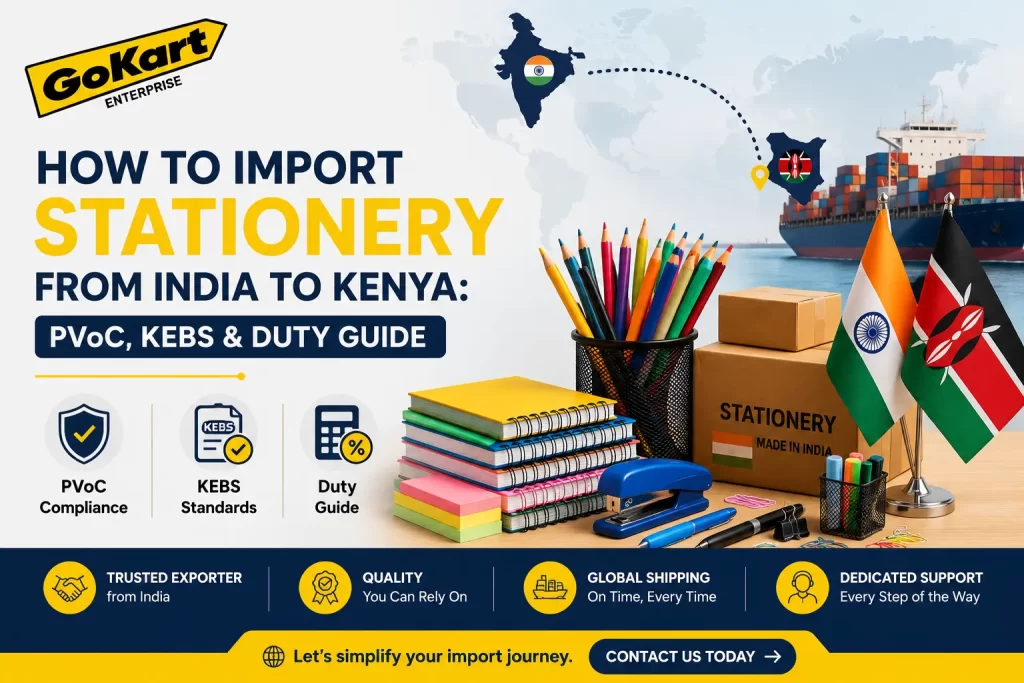
How to Import Stationery from India to Kenya: PVoC, KEBS & Duty Guide

If you run a bookshop chain in Nairobi, supply schools in Mombasa, or win government tenders for office supplies, you have probably noticed the same thing: a large share of the pens, notebooks, and files on Kenyan shelves are made in India. That is no accident. Learning how to import stationery from India to Kenya the right way can lower your cost per unit, widen your product range, and give you a dependable supply line that holds up through peak school seasons. This guide walks you through the whole journey — from picking an exporter and confirming quality, to satisfying the Kenya Bureau of Standards (KEBS), obtaining a PVoC Certificate of Conformity, estimating your duties, and getting your container safely to the Port of Mombasa. The aim is simple: help you import with fewer surprises and clearer paperwork. A quick, honest note before we start. Regulations, levy rates, and approved-agency lists change from time to time. Treat everything here as a practical roadmap, not legal or tax advice — and always confirm the current requirements with KEBS, the Kenya Revenue Authority (KRA), or a licensed clearing agent before you ship. Why Kenya Imports Stationery from India India has grown into one of the world’s most active stationery manufacturing hubs, and Kenyan buyers benefit directly from that scale. Before you work out how to import stationery from India to Kenya in practical terms, it helps to understand why the trade lane works so well — because that context makes it easier to negotiate and plan. Here are the main reasons Kenyan importers keep coming back to Indian suppliers: Put together, these factors explain the appeal: competitive pricing, a mature manufacturing ecosystem, dependable quality, huge variety, and reliable export logistics. For most Kenyan wholesalers and distributors, that combination is hard to beat. Popular Stationery Products Imported from India Buyers rarely import just one item — they build a catalogue. India supplies practically every stationery category a Kenyan retailer, school, or office could need. The most commonly imported lines include: Writing instruments Correction and desk tools Paper and books Filing and office stationery Classroom and creative supplies Whether your focus is school stationery for the January and May buying seasons, office stationery for corporate clients, or art supplies for retail, sourcing across these categories from one reliable exporter keeps your logistics simple and your pricing sharp. Featured-snippet summary: The stationery most commonly imported from India to Kenya includes ball pens, gel pens, pencils, erasers, sharpeners, notebooks, files, markers, whiteboard accessories, geometry boxes, art supplies, and paper products — spanning both school and office ranges. Step-by-Step: How to Import Stationery from India to Kenya Once you know what you want, the how becomes a repeatable process. This is the practical heart of the whole exercise — the full path most importers follow, start to finish. 1. Find an exporter. Shortlist experienced Indian stationery exporters who serve African markets and can support your product mix. (We cover how to vet them further down.) 2. Select your products. Decide on categories, specifications, quantities, and whether you want generic or private-label branding. 3. Request a quotation. Ask for pricing on a clear basis — usually FOB (Free On Board) or CIF (Cost, Insurance, Freight to Mombasa). Confirm currency, MOQ, and lead times up front. 4. Order samples. Never skip this. Samples let you check ink flow, paper GSM, print quality, and packaging before you commit to a full order. 5. Confirm the Proforma Invoice. This document sets out products, quantities, prices, Incoterms, and payment terms. It is also the basis for your Import Declaration Form in Kenya. 6. Agree payment terms. Common structures include an advance deposit with balance before shipment, or a Letter of Credit for larger orders. Agree what protects both sides. 7. Production. The factory manufactures and packs your goods, ideally with your branding and export-grade cartons. 8. Documentation and compliance. Your exporter prepares shipping documents, and — crucially — arranges PVoC inspection so you receive a Certificate of Conformity (more on this below). 9. Shipping. Goods move by sea or air from an Indian port such as Nhava Sheva or Mundra to the Port of Mombasa. 10. Customs clearance. Your licensed clearing agent lodges the entry with KRA, presents your documents and Certificate of Conformity, and pays the assessed duties and taxes. 11. Delivery. After clearance, your container is released and transported to your warehouse or store. Follow this sequence and the process becomes predictable. The two stages first-time importers underestimate most are compliance (step 8) and clearance (step 10) — so plan those early rather than at the last minute. Required Import Documents Customs clearance runs on paperwork. Missing or inconsistent documents are the number-one cause of delays and demurrage charges at Mombasa. Prepare these carefully: Document What it does Prepared by Commercial Invoice States the goods, quantities, and transaction value used to assess duty Exporter Packing List Details cartons, weights, and dimensions for inspection and handling Exporter Bill of Lading (or Airway Bill) The carrier’s contract and title document for your shipment Shipping line / freight forwarder Certificate of Origin Confirms the goods were made in India Exporter / chamber of commerce Certificate of Conformity (CoC) Proves PVoC compliance with Kenyan standards KEBS-appointed inspection agency Insurance Certificate Evidence of cargo insurance (needed for CIF value) Exporter or importer Import Declaration Form (IDF) Kenya’s customs declaration lodged with KRA Importer / clearing agent Import permits (if applicable) Required only for specific regulated goods Relevant Kenyan authority Most standard stationery does not require special import permits, but always confirm your specific products with your clearing agent — classification can hinge on the exact item and its HS code. Keep every figure consistent across all documents; even a small mismatch in quantity or value can trigger a query. What is KEBS? KEBS stands for the Kenya Bureau of Standards. It is the national body responsible for standardisation, quality assurance, and conformity assessment in Kenya. If you import into Kenya, KEBS is one of

Scroll to Top